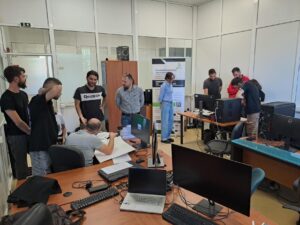
On 18 June, the DIGIFAB project was represented at the 5th International Symposium on Industrial Engineering and Automation (ISIEA 2026), bringing the project’s vision for smarter and more sustainable renovation into an international discussion on the future of industry.
Representatives from RINA and the University of Burgos presented DIGIFAB’s work during the session “T4 – Achieving Sustainable Industry 5.0: The Role of Lean and Digitalization.” Their contribution, entitled “Towards Resilient Construction Sites: A Digital Platform Integrating Safety, Monitoring, and Circular Resource Management,” explored how integrated digital tools can support the management of increasingly complex construction and renovation sites.
Connecting digitalisation, safety and sustainability
Europe urgently needs to accelerate the renovation of its ageing building stock. Buildings account for more than 40% of the EU’s energy consumption and around 36% of its CO₂ emissions, while the annual renovation rate remains below 1%. Addressing this challenge requires renovation methods that can be scaled up while remaining efficient, affordable and sustainable.
DIGIFAB aims to address these challenges. At the heart of the project is a fully digital, BIM-enabled renovation process connecting every phase of the renovation journey, from building diagnostics and assessment to design, prefabrication and final on-site installation. By combining high-precision building data, intelligent BIM tools and prefabricated components tailored to individual projects, DIGIFAB aims to make renovation smarter, faster and more sustainable.
The work presented at ISIEA 2026 focuses on a particularly important part of this journey: how digital technologies can improve construction site monitoring and support the people responsible for managing site activities.
Towards more resilient construction sites
The DIGIFAB methodology presented by RINA and the University of Burgos proposes a BIM-integrated assessment and monitoring platform that brings together key information from the construction site in one digital environment.
The approach combines laser scanning, environmental and acoustic monitoring, BIM-based visualisation and sustainable waste management. By centralising this information, the platform can make relevant site data more accessible to stakeholders and support better-informed supervision and coordination.
Importantly, the platform is designed to support site managers and construction professionals, not replace their regulatory responsibilities. Its purpose is to provide an additional digital layer for collecting, processing and visualising information while minimising interference with ongoing site operations.
The methodology is currently being applied at the Spanish DIGIFAB demonstration site, led by the University of Burgos. Here, the platform will be progressively deployed and validated in a real renovation environment, helping the project assess how integrated digital monitoring can contribute to safer, more efficient and resource-conscious construction processes.
Sharing DIGIFAB’s vision for Industry 5.0
Participation in ISIEA 2026 provided an important opportunity for DIGIFAB to share its ongoing research with the industrial engineering and automation community. The session on sustainable Industry 5.0 offered a particularly relevant setting to discuss how digitalisation can support not only productivity, but also human-centred working environments, resilience and sustainability.
Through collaboration between partners such as RINA and the University of Burgos, DIGIFAB continues to connect digital innovation with real construction and renovation challenges.
The goal is clear: to transform today’s fragmented renovation process into a connected, replicable and sustainable model—and help make deep building renovation possible at scale across Europe.